
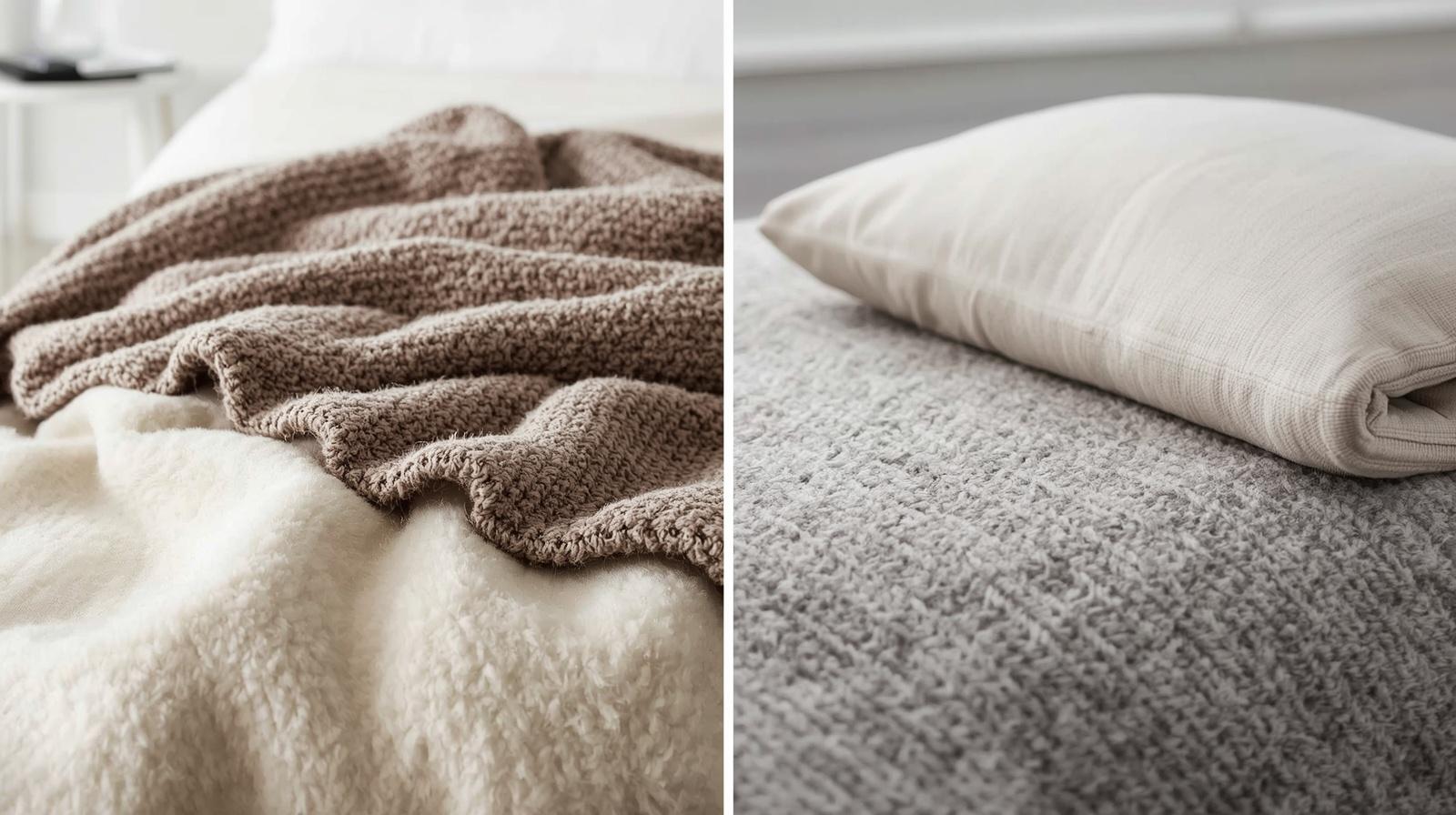
A throw is never just a throw. It keeps you warm on cold evenings. It also makes your sofa look beautiful. The right one does both jobs well.
Today, two options dominate the market. The first is a wool throw, natural, breathable, and used for thousands of years. The second is a fleece blanket, soft, synthetic, and very easy to care for.
Both have their place. But which one belongs in your home? By the end of this guide, you will have a clear answer.
What Each Material Is Made From
Wool throws come from sheep. The fibres are cleaned, combed, and spun into yarn before being woven into fabric. The two types most commonly used in quality throws are Merino wool, known for its fine, close-knit fibre, and Lambswool, taken from a sheep’s first shearing and naturally soft as a result. Neither has been engineered nor chemically altered to perform. The warmth and breathability come from the fibre itself.
Fleece blankets are woven from polyester. The fabric was developed in the late 1970s as a synthetic alternative to wool. During production, the surface is brushed to create its characteristic soft texture. It performs well in certain conditions, but its properties come from how it’s manufactured, not from any natural characteristic of the material.
Warmth, and Why Wool Works Differently
There’s a physical reason wool throw blankets work the way they do, and it’s worth understanding because it changes how you think about the whole comparison.
Wool fibres are crimped. Not straight, not smooth, but wavy at a microscopic level. Those waves create gaps between fibres. Gaps that fill with air. Air that your body heats, and the wool holds in place. That’s what insulation actually means at a structural level, and wool does it naturally.
What makes this more interesting is what happens when wool gets damp. Most insulating materials lose their ability to hold heat when wet. Wool doesn’t, not fully. The fibre can hold a significant amount of moisture and still keep you warm. On a damp British evening, that distinction matters practically.
Fleece traps heat against the body. It works, and in dry cold conditions, it works well. But the fabric doesn’t breathe the way wool does. Heat builds. Moisture builds with it. Some people don’t mind. Others find they wake up overheated after going to sleep cold, a frustrating experience most people blame on the season rather than the blanket.
The Softness Question
Fleece wins on first contact. That’s not debatable.
Pick up a fleece blanket, and it’s immediately gentle. No adjustment period, no breaking in, just soft from the first use. For children or for anyone with skin that reacts to textures, that immediate softness is a real advantage.
Wool throws depend entirely on the type of wool. Cheap, coarse wool scratches. Good wool doesn’t. A Merino wool throw from a quality supplier feels genuinely smooth against skin, including sensitive skin. The problem is that one bad experience with coarse wool puts people off the category entirely, which means many people rule out a material they’d probably love based on something they tried once at a market fifteen years ago.
Moisture and Breathability Over a Full Night
Wool absorbs moisture vapour without feeling wet. The fibre draws moisture away from the skin and retains it internally until conditions allow its release. A wool throw can absorb close to a third of its own weight in moisture before it starts to feel damp to the touch. Throughout the night, that process keeps the surface dry and the temperature stable.
Fleece works differently. The surface resists moisture rather than absorbing it. That’s useful when you’re sitting outside, and the rain starts. It’s less useful when the moisture is coming from you. Sweat that can’t be absorbed remains on the skin’s surface. Over a few hours, that’s uncomfortable in a way that’s hard to ignore.
For a sofa throw used for two hours watching television, this difference barely matters. For anyone sleeping under a warm throw blanket or using it through a full night of cold, it matters quite a lot.
Washing and What Happens Over Time
Wool throws need a cool cycle, a wool detergent, and drying flat rather than hung or tumbled. That’s the full list. The reason for the flat drying is that wet wool stretches under its own weight if it’s hanging. Lay it flat, and it keeps its shape. Follow those steps, and the throw won’t just survive; it’ll still look good a decade from now.
Wool also doesn’t need to be washed often. The same moisture-wicking that keeps you comfortable at night stops odours from developing the way they do in synthetic fabrics. Many people wash their wool throw blanket four or five times a year rather than weekly.
Fleece blankets go straight in the machine on any cycle. That convenience is one of the main reasons people buy them. The issue develops gradually. Polyester fibres break down a little with each wash. The surface pills. Those little bobbles of broken fibre form across the fabric and don’t go away. After two or three years of regular washing, most fleece blankets feel noticeably thinner and rougher than when bought, regardless of how carefully they’ve been maintained.
What Washing Fleece Does to Waterways
Every time a fleece blanket goes through a washing machine, it sheds thousands of microplastic fibres. These fibres are small enough to pass through standard filtration, and they end up in rivers, then oceans, then fish, then food chains. This has been studied and documented consistently for the past decade. It’s not a fringe environmental concern; it’s a measurable, ongoing problem with synthetic textiles at scale.
Wool biodegrades. Put it in the ground, and it breaks down into nothing harmful. Sheep grow the fibre back the following year. For buyers who think about where things go after they’re finished with them, the gap between these two materials is significant.
Price, Spread Over Actual Years of Use
A quality wool throw costs more at the point of purchase. That’s real, and it’s worth acknowledging rather than glossing over.
What changes the calculation is lifespan. A natural wool throw, properly maintained, lasts 15 to 20 years without question. Some last longer. The Grey Checkerboard Wool Blanket and the Beige Fine Checkerboard Wool Blanket are made from 100% pure wool with that kind of longevity built in. Divide the cost by 15 years, and the number is smaller than most people expect.
A fleece blanket bought at a lower price and replaced every two to three years costs more over the same period. Not always, depending on price points, but often.
The Straightforward Answer
Fleece makes sense for children’s rooms, for camping, for anywhere where something affordable and easy to wash is the priority.
Wool makes sense for living rooms, bedrooms, and any area where a throw will be used regularly and is expected to last. It breathes better, regulates temperature better, and holds up to the test of time in a way that synthetic fabrics don’t.
Most people who switch to a wool throw stop looking for alternatives.
FAQs
Is a wool throw actually warmer than fleece?
In sustained cold, yes. Wool traps heat through its natural fibre structure and continues to work even when damp. Fleece traps heat effectively but stops breathing, which causes discomfort over longer periods.
My skin is sensitive. Can I use a wool throw?
Merino wool specifically works well for sensitive skin. The fibres are fine enough that the coarseness people associate with wool isn’t present. It’s worth trying rather than ruling out the category based on standard wool.
How do I wash a wool throw correctly?
Cool machine cycle with a wool detergent. Lay flat on a towel to dry. Do not tumble dry or hang while wet. That’s it.
How long before a fleece blanket starts to look worn?
Most fleece blankets used and washed regularly start pilling within two to three years. The softness noticeably reduces before that, in some cases.
Is fleece actually damaging to the environment?
It sheds microplastic fibres every wash cycle. Those fibres enter waterways. Wool is natural and biodegradable. The environmental comparison is not close.
Leave a Comment
Your email address will not be published. Required fields are marked *